
High school tutoring · Grades 9 to 12
High school tutoring, with a plan for every exam.
When a senior course gets hard, the trouble often began a year or two earlier. We find it, close it and plan your teen’s weeks around their tests, using the study methods research shows work.
- Grades 9 to 12
- Math, sciences, writing, test preparation
- English and French
- Coming soon to Ottawa
Where teens get stuck
Senior courses rest on earlier ones. That’s where we look first.
Common sticking points by subject, the Ontario course they show up in and the earlier skill they often start with.
Linear relations and their graphs
In the Ontario curriculumGrade 9 math (MTH1W)
Often starts withIntegers, ratios and rearranging an equation
Transformations, inverses and trigonometry
In the Ontario curriculumGrade 11 Functions (MCR3U)
Often starts withFactoring and rearranging from Grades 9 and 10
Logarithms, rates of change and derivatives
In the Ontario curriculumAdvanced Functions (MHF4U), Calculus and Vectors (MCV4U)
Often starts withExponent laws, factoring and function notation
Moles and stoichiometry
In the Ontario curriculumGrade 11 Chemistry (SCH3U)
Often starts withRatios and unit conversions from Grades 7 and 8
Motion, forces and energy problems
In the Ontario curriculumGrade 11 and 12 Physics (SPH3U, SPH4U)
Often starts withRearranging formulas with units, and vectors
Dense reading and new vocabulary
In the Ontario curriculumGrade 11 and 12 Biology (SBI3U, SBI4U)
Often starts withReading for structure, and notes that organize it
Analysis that stays on the surface
In the Ontario curriculumGrade 9 English (ENL1W)
Often starts withChoosing evidence and explaining how it works
A lab discussion that doesn’t follow from the data
In the Ontario curriculumEvery science course
Often starts withClaim, evidence and reasoning
An essay thesis that doesn’t hold
In the Ontario curriculumGrade 11 and 12 English (ENG3U, ENG4U)
Often starts withA claim worth defending, and a plan before drafting
Hours of study that don’t show on the test
In the Ontario curriculumUnit tests and final exams
Often starts withRereading notes instead of practising recall
The Grade 10 literacy test
In the Ontario curriculumOntario Secondary School Literacy Test (OSSLT)
Often starts withReading and writing skills expected by the end of Grade 9
Running out of time
In the Ontario curriculumTimed tests in every course
Often starts withPacing, and knowing which questions to do first
Finding the root
A lost mark is a clue. We follow it back.
How a mentor traces one missed Grade 11 Chemistry question to a skill from Grade 7.
Dev knew his chemistry. He doubled where the 2 : 2 ratio meant “the same”, so the plan starts with ratios and units, not more stoichiometry.
Illustrative example.
The six steps of Hikmah tutoringA session
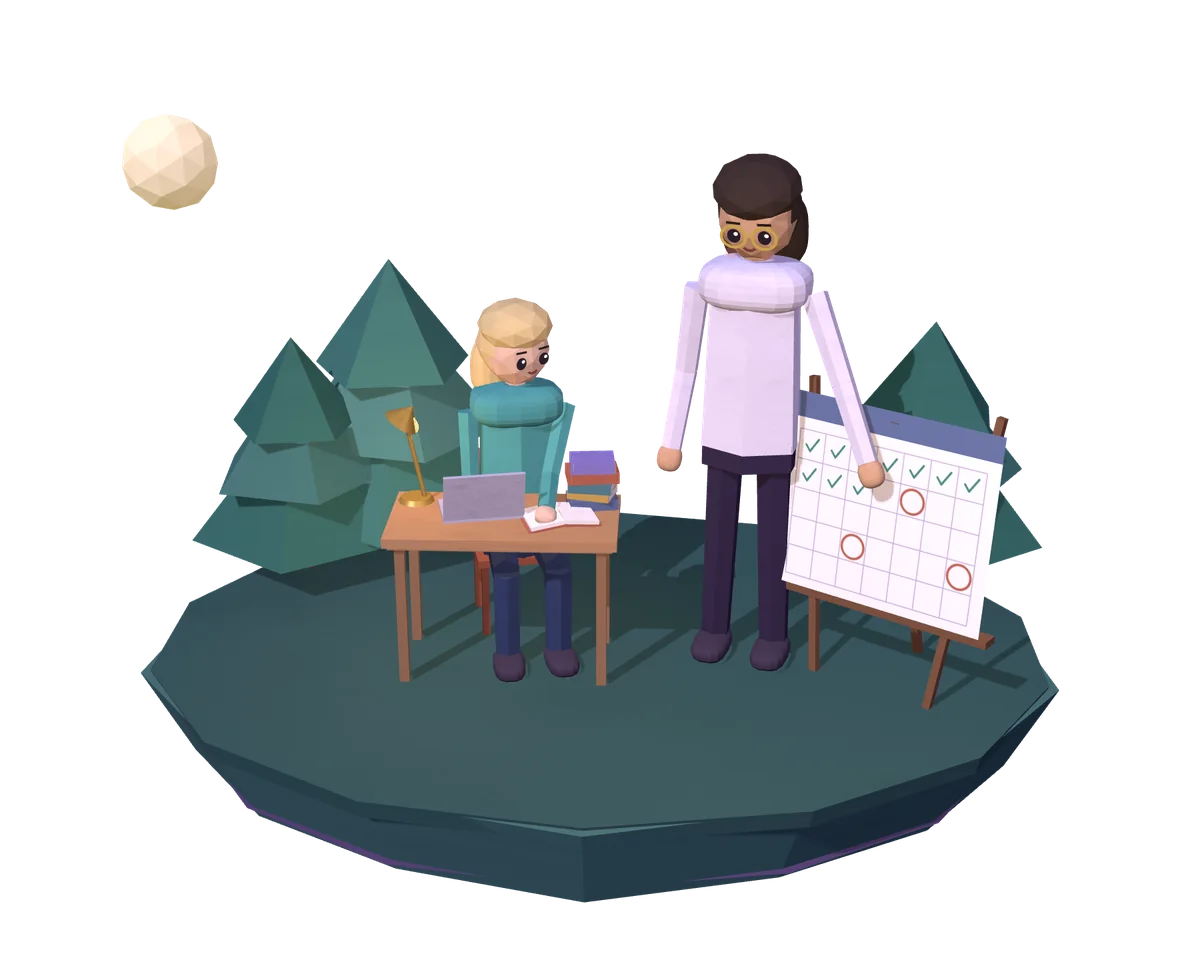
Plan the week, then practise the way that lasts.
Each block is short, and each has a job. Tests and due dates come first, and the plan works back from them.
A session · High school · Dev, Grade 11
- Plan the weekTests and due dates first, then the plan around them.
- Trace the missesLast test’s mistakes, back to the skill underneath.
- Mixed practiceDifferent problem types, so they choose the method.
- Practice testTimed, in the format they’ll see.
- Explain it backThey teach one question to their mentor.
What you receive
You and your teen see the same plan.
Your teen owns the plan; you see how it’s going, in plain words.
- After the diagnostic
- Which earlier skills each course rests on, which are secure and where the trouble began.
- A written learning plan
- Built around their courses, units and test dates, and theirs to read and change with their mentor.
- A progress update every month
- Skills mastered, how the last test went and what’s next.
- A mentor to talk to
- The same person every time, who knows your teen’s courses and goals.
The +
Marks open doors. Judgement decides which ones.
Alongside the courses, your teen builds what universities, employers and a world with AI will ask of them.
Think critically
AI as a sparring partner
Asking it to argue the other side or check their reasoning, never to write their work.
Create
A portfolio of real work
A research paper, an experiment presented to an audience, a business plan.
Decide
Planning what comes next
Course choices and applications, worked through with their mentor and with you.
Lead
Leading their own learning
Planning their weeks, and knowing how they study best.
Questions from parents
What parents of teens ask about tutoring.

Is it too late to start in Grade 11 or 12?
No. The hardest part of a senior course often rests on one earlier skill that can be fixed directly, and the plan works around the tests still to come.
Can you help with one course, like Calculus?
Yes. The diagnostic looks at that course and the skills it rests on, and the learning plan follows its units and test dates.
How does test preparation work?
The plan works back from each test date: trace the last test’s mistakes, practise with mixed questions, then a timed practice test in the format your teen will see. Spaced review keeps earlier units fresh for the final exam.
Do you help with university applications?
Yes, as part of the high school program: course choices, application essays and a portfolio of real work. Details will be shared with founding families before we open.
My teen doesn’t want a tutor. What then?
Many don’t. Most do want calmer weeks and a plan they control. Their mentor works with them, not on them, and the learning plan is theirs to read and change.
Keep exploring