
Learning by conversation
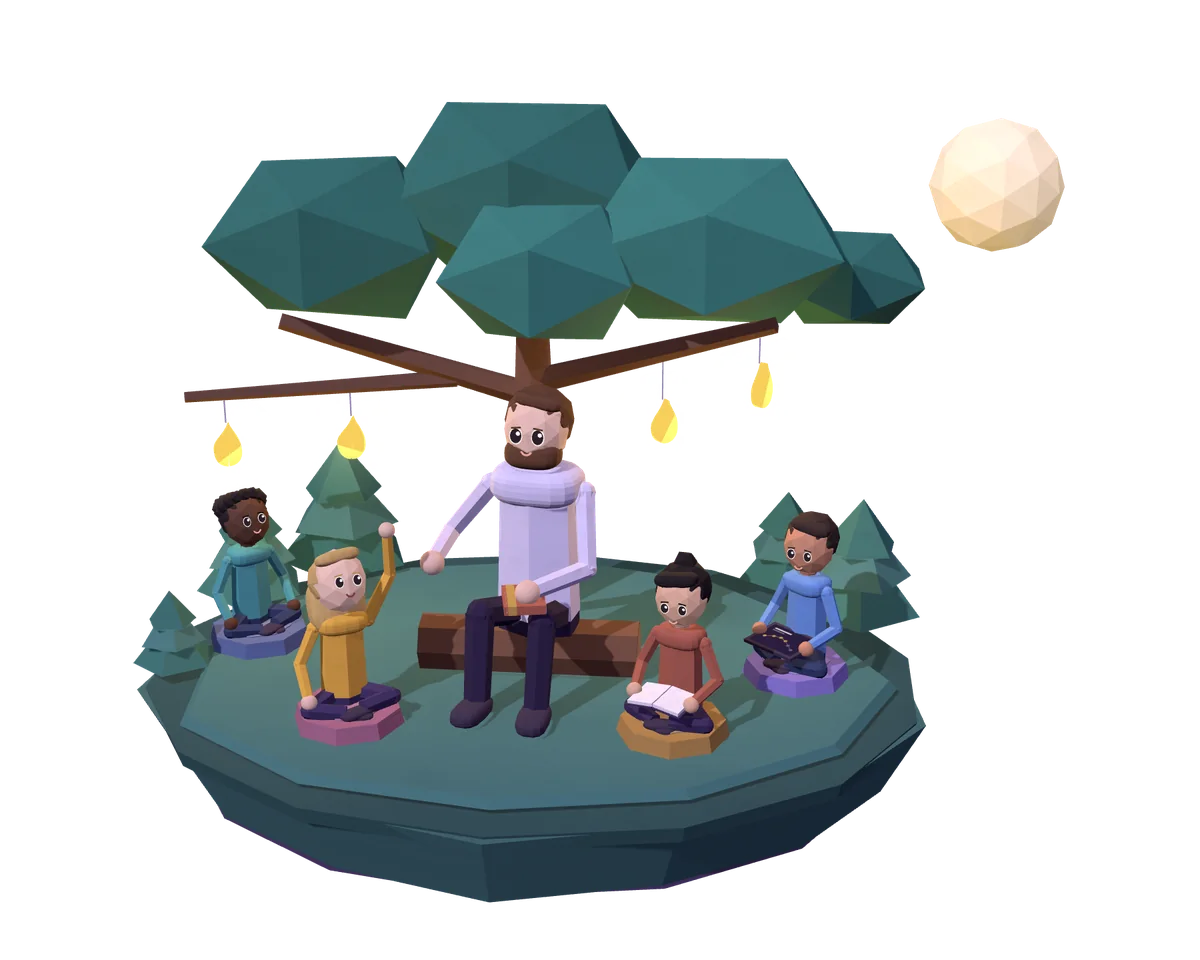
Confucius taught through conversation, and asked students to think about what they learned, not only remember it.
Ancient principles, modern tools
Your child learns the way the best students always have: beside a mentor who knows them, with good questions and real work.
At a glance
Here is what they mean for your child.
Their mentor asks the questions, so your child does the thinking, and learns to ask good questions too.
Reading closely, writing clearly and the basics of math, practised until they’re secure.
Your child learns to give reasons, weigh the other side and explain it to a real audience.
The trivium, today
Grammar, logic and rhetoric still describe what a capable thinker needs, perhaps more than ever when a machine can write fluent text on demand. Here is how they shape one session with Mateo, in Grade 3.
Session · Thursday
From memory: what does a plant need?
Light, water and air are secure. Soil: let’s test it.
Words he’ll need today
Testing a claim
Plants need soil.
How do you know?
All our plants grow in soil.
This lettuce grew in water. What does that tell us?
Maybe it isn’t the soil. It’s what’s in it.
His claimPlants need soil.
NowPlants need nutrients. Soil is one way to get them.
His explanation
Explained to his family, at pickup
His dad asked: “So why do farmers use soil?”
Illustrative example.
The mentor tradition
For centuries, the children of kings were taught by a mentor who built every lesson around them. Almost no one else could have it.
Hikmah brings that attention to every family, with the apprentice’s oldest method.
The mentor thinks out loud, so your child sees how an expert works.
Your child tries; the mentor watches closely and asks the next question.
Support fades as your child takes over, until they can do it alone.
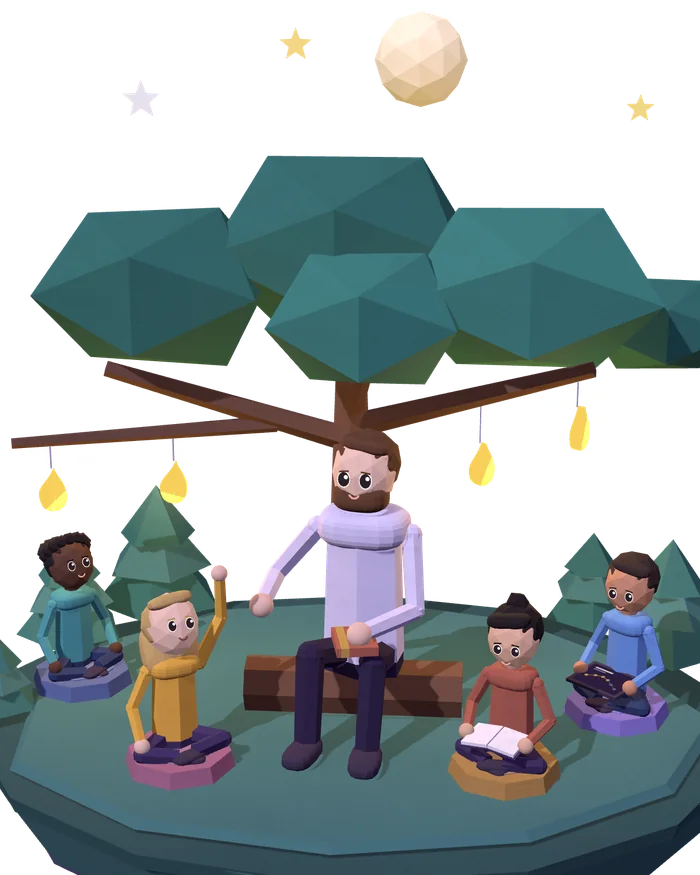
Confucius taught through conversation, and asked students to think about what they learned, not only remember it.
Socrates taught by asking questions, helping his students test their own ideas and find the gaps.
Grammar, logic and rhetoric: how language works, how to reason, how to persuade.
A great centre of learning where students and teachers tested ideas through debate.
Scholars gathered to translate, test and teach. Hikmah means wisdom; we take our name from this tradition.
Crafts were learned by making real things beside an expert who watched closely and corrected.
Vittorino da Feltre in Mantua set out to educate the whole child: letters, mathematics, music and exercise.
Maria Montessori and John Dewey argued that children learn best through hands-on work and real problems.
Modern tools take on the tracking and the practice, so every child can have a mentor’s close attention.
Modern tools
Close mentoring never scaled because tracking every skill and preparing practice take so much time. The Hikmah platform, in development, is designed to carry that load.
See the platformFor your family
Your progress update shows more than marks: a question your child asked, a claim they changed and what their mentor is building next.
Hikmah Tutoring+
Progress update
NovemberA question he asked
“If lettuce can grow in water, what is soil for?”
A claim he changed
From “plants need soil” to “plants need nutrients, and soil is one way to get them.”
Foundations
Next
Mateo explains his plant test to the group on Thursday and takes their questions.
The difference
Lectures and worksheets cover ground quickly. Good questions make sure your child is the one doing the thinking.
Who does the thinking
The usual wayThe adult explains; the child copies it down
At HikmahThe mentor asks; the child reasons it out
A wrong answer
The usual wayMarked wrong, then corrected
At Hikmah“How do you know?”, until your child finds the gap
An argument
The usual wayOne side, in an essay for the teacher
At HikmahBoth sides weighed, then defended to a real audience
Who they learn with
The usual wayWhoever is free that day
At HikmahThe same mentor, who knows how your child thinks
Showing what they know
The usual wayA test
At HikmahExplaining it, and answering questions
The research
Hikmah hasn’t opened, so we have no results of our own yet. Here is the research on discussion, argument and apprenticeship that our sessions build on, and what we’ll track from the first day.
Meta-analysis · Classroom discussion
Several discussion approaches sharply increased how much students talked and improved their understanding of what they read. Only a few also improved critical thinking and reasoning, so the method matters.
Murphy, Wilkinson, Soter, Hennessey and Alexander (2009). Examining the effects of classroom discussion on students’ comprehension of text: A meta-analysis. Journal of Educational Psychology, 101(3), 740–764. Read the source (opens in a new tab)
Randomized trial · 76 schools · ages 9 and 10
In England, children aged 9 and 10 whose teachers were trained in dialogic teaching made about two months’ more progress in English and science, and one month in math, than children in comparison schools. A later check on national tests found no difference.
Education Endowment Foundation (2017). Dialogic Teaching: evaluation report, independent evaluation by Sheffield Hallam University; addendum 2019. Read the source (opens in a new tab)
Three-year study · Middle school · with a comparison group
Students who argued social questions with classmates, then wrote, produced essays that weighed both sides more often than a comparison group that wrote more essays.
Kuhn and Crowell (2011). Dialogic argumentation as a vehicle for developing young adolescents’ thinking. Psychological Science, 22(4), 545–552. Read the source (opens in a new tab)
Framework · How experts teach thinking
Cognitive apprenticeship describes how experts make their thinking visible, coach while the learner tries, then fade their support. It is the model behind our mentors’ show, coach and step back.
Collins, Brown and Holum (1991). Cognitive apprenticeship: Making thinking visible. American Educator. After Collins, Brown and Newman (1989). Read the source (opens in a new tab)
Reading the numbers: effects are in standard deviations. An effect of 0.5 moves an average student from the middle of the group to about the 69th percentile.
What we’ll measure
Hikmah has no results yet. These are the questions we’ll track for every child, and publish methods first.
See our research agendaHow much of each session your child spends explaining and reasoning, from their mentor’s notes.
Writing and talks scored on one rubric (the claim, the reasons, the other side), term after term.
Short tasks with a flaw to find, including AI-written ones, when your child starts and through the year.
The best education has always been personal. Now it can be personal for everyone.
Join our founding families in Ottawa. When we open, a free diagnostic assessment shows us where your child is, and shows you how we work.