
University and college admissions · Grades 9 to 12
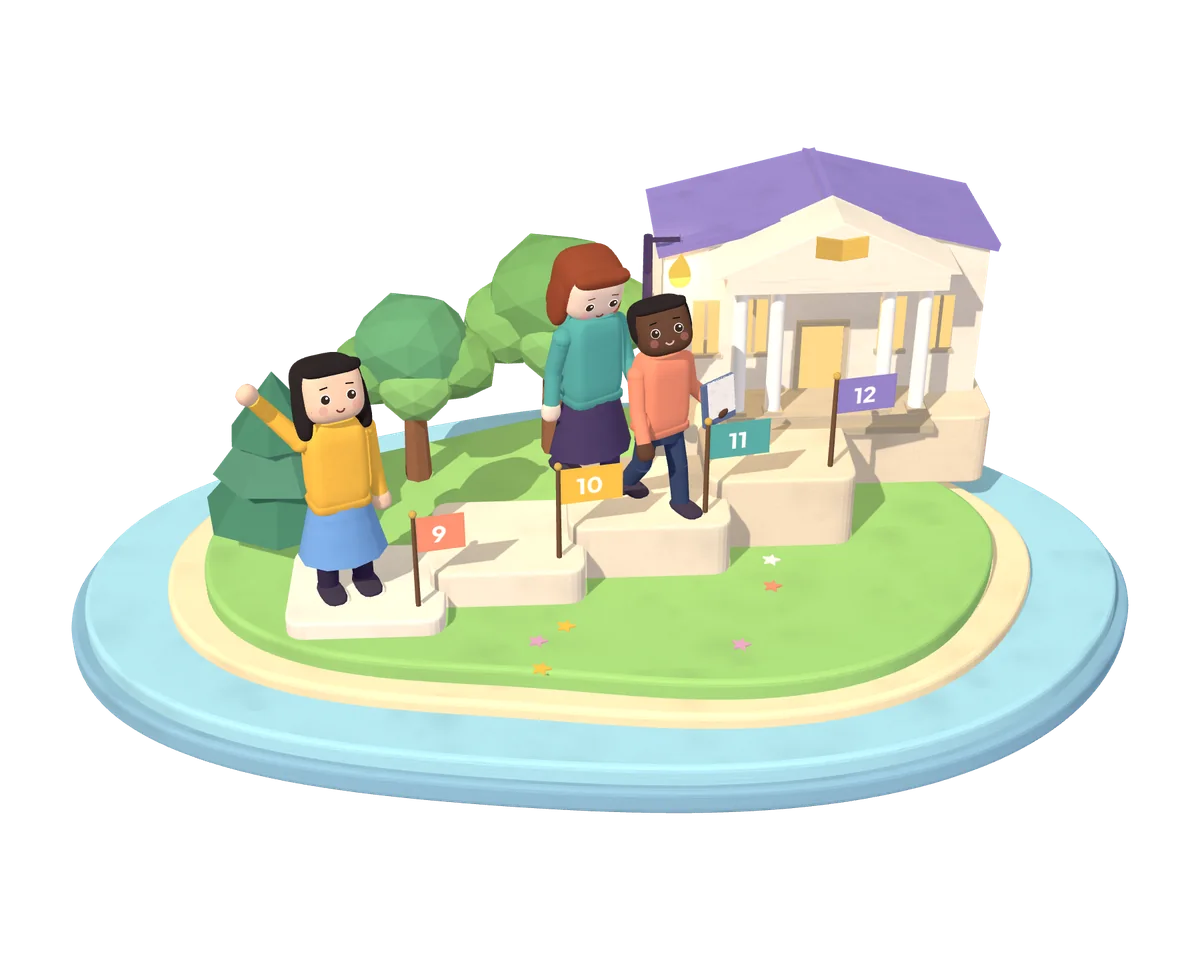
The road to university or college starts in Grade 9. Your teen walks it with a mentor.
Course choices, marks, essays and interviews: we help your teen plan each step, alongside their school’s guidance counsellor, and build a record of real work on the way.
- Grades 9 to 12
- One mentor
- Ontario universities and colleges
- Coming soon to Ottawa
Who it’s for
University and college feel far away. The choices that lead there start now.
Situations parents of teens often describe, from Grade 9 to the last spring of high school.
Choosing Grade 9 courses, with no idea what they lead to.
Grade 9 courses are de-streamed in Ontario, and nothing in Grades 9 and 10 is meant to lock a door, though Grade 10 choices can affect Grade 11 prerequisites. A plan helps.
Curious about engineering, nursing or business, but which courses does that take?
Each program lists the Grade 12 courses it requires. Planning back from them in Grade 10 avoids a surprise in Grade 12.
Marks are slipping in a course a program requires.
A required course is worth fixing at the root, early, before Grade 12 marks are sent.
The application asks for an essay, and the page is blank.
Some programs ask for a supplementary form, an essay, an interview or a portfolio. Writing well about yourself can be learned.
Has done real things, but can’t show them.
Projects, leadership and volunteering become a portfolio when someone helps your teen collect them and say what they learned.
Doesn’t know yet what to study.
That’s common, and fine. Exploring programs is part of the plan, and so is changing your mind.
Recognize your child here? A diagnostic assessment is the first step, and it will be free for founding families. See how Hikmah approaches it
How we help
A plan through the grades, with one mentor beside your teen.
The same steps as all Hikmah tutoring, applied to the road from Grade 9 to an offer. We work alongside your teen’s guidance counsellor, and your teen and your family decide.
The diagnostic
Where your teen stands
Their courses, marks and interests, the skills under any shaky course and the programs they’re curious about.
The root
What a goal really needs
Each program lists its required courses. We trace back from those to the courses and skills that need work now.
The plan
A plan, season by season
A written learning plan: courses to choose, courses to strengthen and application steps by season. Your teen and you each get a copy.
One mentor
The same mentor, wherever possible
Wherever possible, one mentor from Grade 9 to the offer, who knows your teen’s courses, writing and goals and works alongside the school’s guidance counsellor, never in place of them.
Mastery checks
Support in key courses
Tutoring with mastery checks in the courses each program requires, to help keep a key course from slipping in Grade 12.
Updates and the +
Updates, and real work to show
A progress update for you every month, and projects for a real audience your teen can draw on in an essay or an interview.
A session · Admissions · Gabriel, Grade 12
- This month’s calendarDeadlines, and what programs ask for.
- Calculus, at the rootThe one skill holding his mark back.
- Mastery checkFresh questions, short and low-stakes.
- His essay, second draftRead aloud, then his mentor’s questions.
- Mock interviewTwo questions, then one thing to improve.
Grade by grade
Admission starts long before the application. Here is the road, stage by stage.
What happens at each stage in Ontario, from the official pages, and what Hikmah will do alongside.
Grade 9
Course choices that keep doors open
In Ontario, Grade 9 courses are offered in a single stream, de-streamed or open. Course types begin in Grade 10 (academic, applied or open), and the policy says students aren’t expected to make binding decisions about a pathway in Grades 9 and 10.
At Hikmah
- Course choices talked through with your teen, before the school’s deadline
- Root gaps in math and English found and worked on early
- A start on the 40 hours of community involvement, which can begin the summer before Grade 9
Grade 10
The literacy test, and a look ahead
Students are expected to write the OSSLT (in French-language schools, the TPCL) in Grade 10, and passing it is how most meet the diploma’s literacy requirement. Grade 11 choices come next, and senior courses can have prerequisites, so this is the year to look ahead.
At Hikmah
- Reading and writing built up for the literacy test
- Grade 11 courses chosen with the programs your teen is curious about in view
- Community involvement that means something to your teen, logged as it happens
Ontario: earning your high school diploma (opens in a new tab)
Grade 11
U and M courses, and exploring programs
Grades 11 and 12 offer university preparation (U), university/college preparation (M), college preparation, workplace preparation and open courses. Applying to an Ontario university from high school means presenting six Grade 12 U or M courses, including the ones each program requires; each program lists them on its own admission page.
At Hikmah
- Programs explored, and their required courses checked against your teen’s plan
- Tutoring in the Grade 11 courses that lead to them
- A portfolio started: projects, research and leadership, at Hikmah and beyond
Grade 12 · Fall
University applications
Ontario high school students apply to Ontario universities through the province’s central application service, by its deadline for high school students (January 15 for fall 2027 entry); after that, each university sets its own. Some programs also ask for a supplementary form, a personal essay, an interview or a portfolio.
At Hikmah
- A calendar of the deadlines your teen’s programs set
- Essays and supplementary forms planned and revised, in your teen’s own words
- Interview practice, aloud, with feedback
Grade 12 · Fall to spring
College applications
Ontario colleges share one online application, open from the fall; applying by February 1 gives equal consideration. Colleges can make offers from November 1, and most ask for a reply by May 1.
At Hikmah
- Each program’s admission requirements checked against your teen’s courses
- Applications planned around the February 1 date
Grade 12 · Winter and spring
Marks and university offers
Your teen’s school sends Grade 12 marks to the application service during the year, and first-term marks are often among the first universities see. Ontario universities make offers from about December; applicants who applied by January 15 hear by late May, and no university can require a reply before June 1.
At Hikmah
- Tutoring in key courses through to the end of the year
- Offers compared with your teen and your family, who decide
Dates and requirements change every year and differ by program. Check with your teen’s guidance counsellor and on each program’s own page for this year’s details.
How it’s different
Application help often starts in Grade 12. Ours starts with Grade 9 courses.
Both have their place. Here is how last-minute application help compares with a Hikmah admissions session.
| Last-minute | Tutoring+ | |
|---|---|---|
| Starts | In Grade 12, when the essay is due | As early as Grade 9, with course choices |
| The essay | Edited line by line | Planned and revised by your teen, with questions and feedback |
| Marks | Not part of it | Tutoring in the courses each program requires |
| What your teen can show | A list of activities | A portfolio of real work, explained in their own words |
| The school | Separate from it | Alongside the guidance counsellor, never in place of them |
Illustrative example. Session plans and lengths will be shared with founding families before we open.
What you receive
You’ll know what’s due, and what your teen decided.
Your teen owns the plan; you see how it’s going, in plain words.
- After the diagnostic
- Where your teen’s courses and marks stand, set against the programs they’re curious about.
- A written learning plan
- Courses to choose, courses to strengthen and application steps by season, for your teen to read and change with their mentor.
- A progress update every month
- Skills mastered, application steps done and what’s next.
- A mentor to talk to
- Who knows your teen’s goals, and leaves the decisions to your teen and your family.
The research behind it
Essays, marks and a mentor. What the research says about each.
Hikmah hasn’t opened, so we have no results of our own yet, and no study can say who gets in. Here is what other researchers found about the parts we help with.
Teaching the writing
A meta-analysis of writing instruction from Grades 4 to 12 found that explicitly teaching strategies for planning, revising and editing had among the largest effects of any approach studied.
At Hikmah: Your teen will learn to plan and revise an application essay, and will write every word of it.
Feedback on drafts
Feedback helps most when it answers three questions for the learner: where am I going, how am I going and where to next.
At Hikmah: Every essay draft and mock interview will end with what works, what doesn’t yet and the next step.
Source: Hattie and Timperley (2007). The power of feedback. Review of Educational Research, 77(1), 81–112.
Tutoring, across the grades
A review of 96 randomized tutoring studies, mostly in elementary school, found reading tutoring tended to work best in the earliest grades and math tutoring in Grades 2 to 5; few studies reached high school.
At Hikmah: In a senior course, the diagnostic will find which earlier skill is holding the mark back.
A relationship that lasts
Across 99 studies, warm teacher–student relationships went with stronger engagement and, more modestly, with achievement. These are associations, not proof of cause.
At Hikmah: The study was of teachers, not mentors. We take its lesson: wherever possible, the same mentor will stay with your teen from course choices to offers.
Questions from parents
What parents ask about university and college admissions.

Can you get my teen into a particular program?
No, and no one honest can promise that. Admission decisions belong to each university and college. We help your teen make the strongest honest application they can: the right courses, steady work in them, and essays and interviews in their own voice.
Do you replace the school’s guidance counsellor?
No. The guidance counsellor knows your teen’s school, its courses and its part in the application. We work alongside them, and the decisions are your teen’s and your family’s.
Will you write my teen’s essay?
No. The essay is theirs: we help them find what to say, plan it and revise it, with questions and feedback. The same goes for AI: they can use it to question a draft, never to write it.
When should we start?
Grade 9 or 10 is best for course planning, since later choices build on them. It’s never too late, though: in Grade 12, the plan starts from this year’s deadlines.
What if my teen wants to study outside Ontario or in the US?
Universities in other provinces don’t use Ontario’s application service, so each one’s own application and dates go into the plan. In the US, each college sets its own admission plans and deadlines, even when colleges share an application form. Check each college’s own policy on SAT and ACT scores; our test prep page covers those tests.
Does my teen need to know what they want to study?
No. Exploring is part of the plan, and plans change. Strong marks in a range of Grade 11 and 12 U and M courses keep more programs open while your teen decides.
Is admissions help available in French?
Yes. Sessions will be in English or French. How sessions in French will run will be shared with founding families before we open.